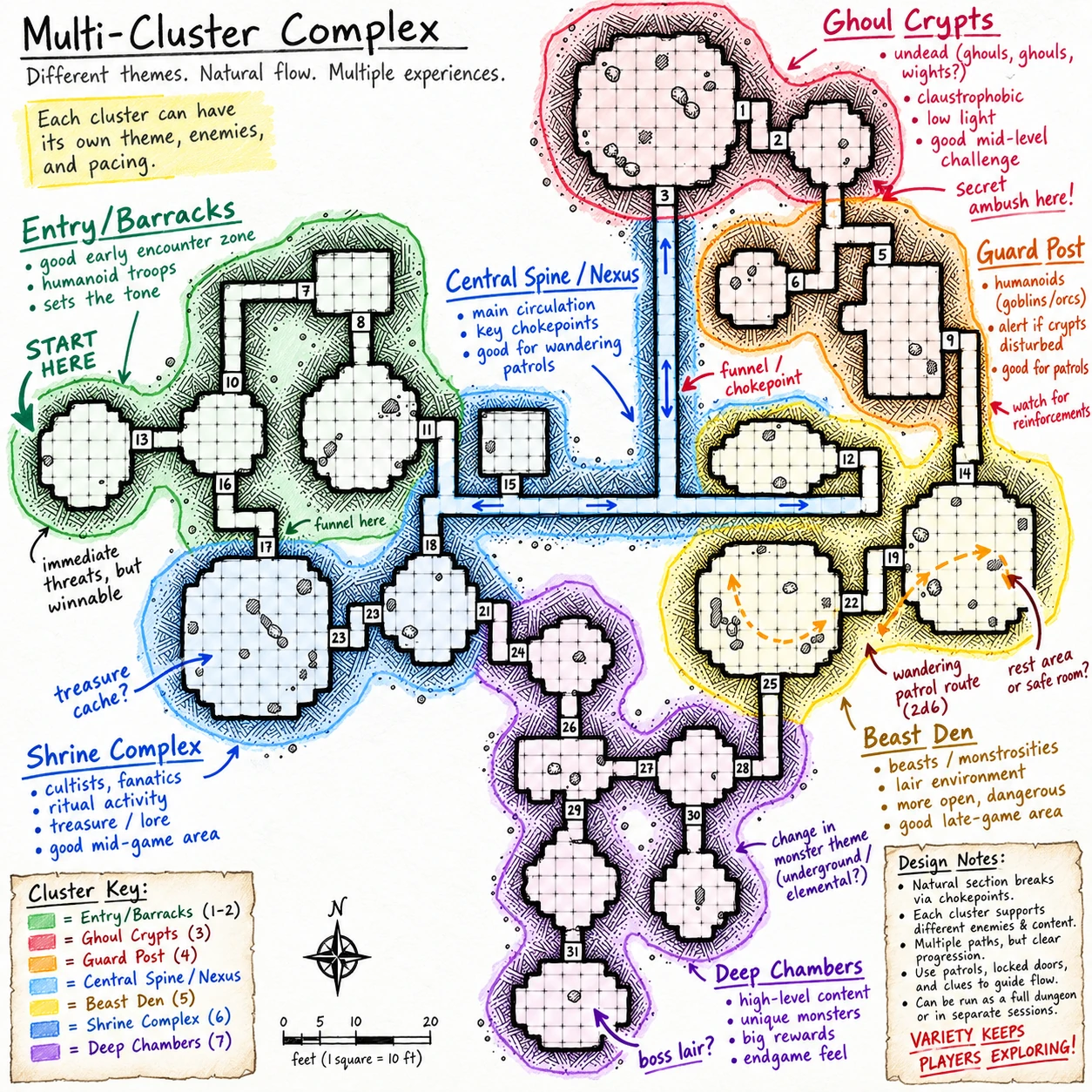
Dungeon Design pt 4: Multi-Cluster Dungeons
Put a single passage between two dungeon districts and suddenly the party has ground to hold, borders to cross, and an escape route somebody else can take away. Multi-cluster dungeons make faction territory and desperate retreats emerge from the map itself. They're also one blocked door away from a stalled session. Here's how to draw my favorite layout of the four, and keep its chokepoints from becoming chores.
This is the fourth post in my series on dungeon arrangement, where I've been arguing that where rooms sit relative to each other does about as much work as what's in them. Last time I said a clustered layout gives you neighborhoods but not borders, and this post is about the layout that gives you borders. It's my favorite of the four by a decent margin.
I call it multi-cluster, which is a dull name for a layout built from three or so districts that are each tightly connected inside and joined to one another by as few passages as you can get away with. Nearly everything good about it comes from those few passages.
How it differs from a clustered map#
A multi-cluster map looks a lot like the previous article's clustered one at a glance, with groups of rooms and open rock between them, and the difference only shows up when you trace how the groups connect. In a clustered map the groups are visual. Rooms near the seam link up with whatever is closest on the other side, so there are usually three or four ways across and the party can slip between the halves almost anywhere. In a multi-cluster map the districts are structural, with rooms connecting freely inside each one and only one or two passages running between them.
The test I've started running on every map I draw is simple enough to do with a pencil. Lay it over a single passage and ask whether the map just fell into two pieces. If it did, that passage is what graph people call a bridge (a room with the same property is an articulation point). That's the strongest kind of chokepoint: losing it cuts off a whole district. A narrow passage can still be worth defending when another route exists, but it won't pass this test. A clustered map fails the test almost everywhere, while a multi-cluster map built as a gauntlet can pass it in two or three places, and those are the places your sessions will end up happening.
What it does well#
The most obvious strength is that a chokepoint can be held, and holding ground turns being outnumbered from a death sentence into a tactical problem the players can work on. Anybody who has run old-school combat knows what happens when the fighter plants himself in a ten-foot doorway and the rest of the party works behind him. That play pattern needs a place to happen, and this layout puts one between every pair of districts.
Chokepoints can also be closed or lost, and in my experience that's where the good sessions come from. A passage collapses or somebody drops a portcullis behind the party, and getting home becomes a problem to solve instead of a walk to take. Worse, something takes the bridge while the party is on the far side of it. The most famous dungeon scene in fantasy fiction happens on the Bridge of Khazad-dûm, and a big part of why it works is that the Fellowship had exactly one way out.
What I find most useful as a referee is that districts give you territory, with the bridge standing in as the border. Put a guard on it and the players will read a faction down there as organized without you saying a word, because the map has already taught them how the place is divided.
The Caves of Chaos in The Keep on the Borderlands are the best example of this I know. The module scatters faction lairs through different parts of a ravine, each one a small district of its own, with some of them connected to each other and others not. That arrangement gives a party a lot of ways to play it. They can isolate one tribe and pick it apart, get caught between two lairs they didn't realize were linked, or stir up one faction and send it into its neighbors. Most of what makes the Caves fun comes out of who lives next to whom and how their lairs connect.
Districts also make progress easy to see, since crossing into the second one means something and "we hold the first district" is a sentence players can plan around. You can raise the danger district by district and get some of the feel of descending levels without leaving the level. I've also found bridges handy for ending a session, because stopping at a border feels natural in a way that stopping somewhere in the middle of a sprawl never does.
Where it falls down#
Backtracking is the biggest weakness of this layout, and I don't think there's a way to design it out entirely. If the objective sits in the third district and the party has to cross two bridges to get home, that walk takes real time at the table with nothing happening in it. This layout produces the longest travel of the four, and travel that isn't dangerous or interesting is just bookkeeping with a map attached.
Stalling is the other big risk, because a chokepoint is also a bottleneck and a bottleneck is how sessions die. There's a version of this where the party spends forty minutes failing to get through one door and everybody goes home mildly annoyed with each other, and I've been on both sides of that evening. If a bridge only has one solution, the players will feel like they're waiting for you to hand them the key.
A strictly linear version can also feel like a railroad. Three districts in a row with one bridge each and the objective at the far end is really a corridor of rooms with some extra space around it, and players who love poking into corners will notice they're being funneled.
The added danger cuts both ways as well. Losing a bridge while the torches are running low is the kind of pressure old-school play is built on, but for a small or low-level party it can turn into a death spiral quickly. That's fine if it's what you want, as long as you know this layout makes it more likely.
It also needs a fair number of rooms to work. Three districts want twenty or more before they read as districts rather than clumps, and with twelve rooms you mostly get three little knots and a lot of hallway.
When to reach for it#
I reach for this layout when the fiction has a story about who controls what. Faction territory and sieges fit it well, and so does a keep with an outer and inner ward, a complex built in stages by different people, or a ruin where collapses have left the sections touching in only a few places. If you can answer "whose side of the bridge is this?" the layout will pay you back.
It suits levels the party will come back to over several sessions, since territory builds up and a bridge they've held matters more the third time they cross it. For a one-night crawl it's often more structure than the evening needs. If you want the players genuinely lost, the wandering organic layout does that better, and if you want constant pressure with no room to breathe, the dense interior does. Multi-cluster is the one I use when the dungeon is about control.
Drawing one by hand#
Drawing one starts the same way as a clustered map, with a blob for each district, except you push them further apart.
This example uses the web version of the layout, with loops between districts. The narrow entrances still give you places to defend, but holding one doesn't necessarily cut off the district because the party can take another route. I'll come back to that choice between a gauntlet and a web below.
The step people skip, and I skipped it for years, is finishing each district internally before drawing a single passage between districts. Fill district one and connect it to itself, then do district two, and only when they're both done do you ask how they touch. Skipping that is how you end up with visible groups and no real border, which is just the clustered layout wearing a costume.
When you connect the districts, use one passage between them, or two if a district is big. The urge to add a third because some corner looks lonely will dissolve the whole structure, and I've given in to it more than once and regretted it every time. Run the pencil test when you're done and make sure the bridges you meant to have are actually there.
Every bridge needs something on it, whether that's a door, a guardpost, a collapsed stretch you have to climb through, or a smell that gets worse the closer you get. The map has already decided that spot matters, and leaving it as blank corridor throws away the main thing this layout offers. I also like giving each bridge a second, costlier way across, like a crawlspace or a guard who takes bribes, so the players always have more than one way to attack the problem.
Bridges can run vertically as well. A stair, a shaft, or a chute between districts at different depths works the same way as a corridor and is a lot harder to go around.
Secret doors between districts are my favorite addition to this layout, because they give the bridge structure a hidden layer the players can use in ways you never planned. The map they can see passes the pencil test and the one you're holding doesn't, and once they find the hidden route they might slip past the guardpost or get out when the main bridge falls. It gives searching a real payoff, since a successful search can change the shape of the level.
A secret door is also a hint about the story of the place. A hidden passage between two districts means somebody wanted those two places connected without anyone else knowing, maybe for smuggling, or maybe because two factions who hate each other in public have a private arrangement. Players who find one will start asking who made it and why, and that question will do more for the dungeon than most of what I'd write in the key.
The last thing to do is fix the backtrack before it happens by putting a shortcut near the objective that only opens from that side. It's one of the oldest tricks in dungeon design, and every module with a one-way door out of the bottom level was solving exactly this problem.
Connecting the districts is its own decision#
How many ways you connect the districts is a separate choice from where you put them, and it changes the dungeon completely. One bridge between each pair in a line gives you a gauntlet with three territories and one way through each, while loops between every pair give you a web where the territories are still there but holding one passage no longer seals off a district. I think both make good dungeons, and the mistake is ending up with one by accident.
The old-school dungeon crawl on OSRIC 3.0 I've been building handles this the same way. Its generator places the districts and wires up each one internally first, and then a separate connection setting decides whether they get joined as a gauntlet or a web, so the same seed can produce either dungeon from identical rooms. If readers take one idea from this whole series, I'd want it to be that arranging rooms and connecting them are two decisions, and treating them as one is why so many maps (a fair number of mine included) only ever have one mood.
Gift or chore#
I'm a little suspicious of how much I like this layout, since everything good about it comes from the same bottlenecks that can stall a session. Still though, I'd rather have the gate and misuse it than not have it. A map with no structural pressure gives me nothing to work with, and I can always decide the door I said was stuck turns out to be merely heavy.
So which is it for you, a gift or a chore? I've run both outcomes off the same kind of map and I still can't tell whether the difference was the map, the party, or me having a good night. And if you've got a trick for making the walk back across two districts worth the table time, I'd genuinely like to steal it.
Drop a comment on X and let me know your thoughts!