Better Dungeon Design Part 3: Clustered Complex
Split a dungeon level into two close clusters of rooms and something odd happens: players start naming the sides, clearing turns into territory, and "let's finish the east side and camp" shows up without a word in the key. Here's why the clustered complex is the most underrated layout of the four, what it hands the GM for free, and the chokepoint it promises but never delivers.
This is the third post in my series on how the arrangement of rooms changes the way a dungeon plays. Last time was the dense layout that crams everything into one mass. This time it's the clustered complex, which I think is the most underrated of the four, mostly because it changed how my players behaved more than any of the others did. That's a big claim and I'll try to earn it.
When the rooms on a level fall into two visible groups, players start making plans. I didn't design for that, and it took me a while to work out why it happens and where it stops working.
The layout that gets players naming things.
Two neighborhoods, one dungeon#
The layout itself is simple. Two groups of rooms sit close together, with a gap between them that's smaller than either group, so anybody looking at the map reads two parts of one place. Make the gap much bigger and they read two dungeons that happen to share a page, which is a different thing.
The worked example all series has been the old-school dungeon crawl I'm building on OSRIC 3.0, the one where the dungeon is the opponent. Its generator does this with two magnets. It puts a center on either side of the level, deals the rooms out to them alternately like cards, and nudges each room a couple of squares so the groups don't look stamped out. Two magnets and a bit of noise, and that's the entire policy.
Naming is planning#
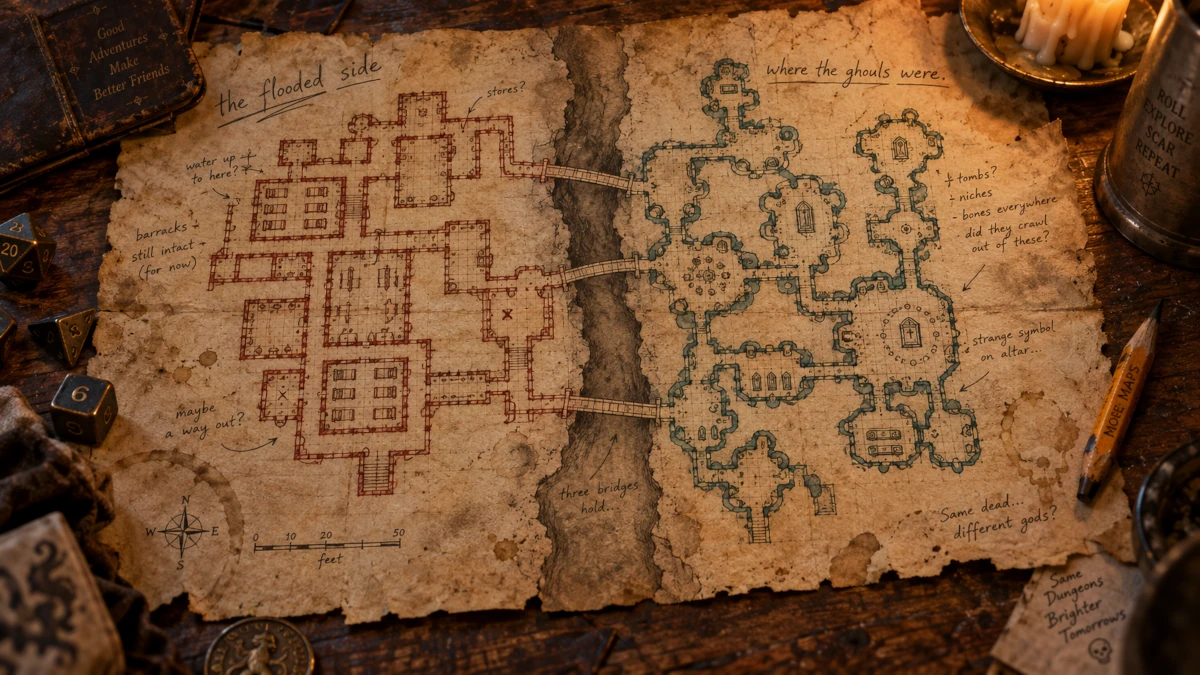
When a dungeon has groups, players name them, and nobody asks them to. It usually starts somewhere around the second session. The flooded side. Where the ghouls were. That whole wing with the statues in it. I've had a table call an area by a name for six months that came from one description I gave offhand and forgot about immediately.
The naming is the tell that they've built a map in their heads, and you can't make a plan about a place you can't picture. Once the two sides have names, sentences start showing up that I never put in anybody's mouth. "Let's finish the east side, camp there, and push west in the morning." "East is clear, so if this goes badly we run that way."
That's players weighing time and risk against a map, and I didn't write a word of it into the key. The spacing did it.
It reminds me of how we all used to talk about the big published megadungeons. Nobody said room 47. They said the place with the pool, or upstairs where we lost Bran. I think that vocabulary shows up a lot faster when the map has visible parts, and I think an even scatter of rooms actively gets in its way.
What it gives the GM#
Clearing adds up, and that's worth more than it sounds. In a spread-out dungeon, cleared is a property of single rooms and it doesn't hold. The party clears room seven, walks past four others, and by the time they come back nobody trusts room seven anymore. In a clustered dungeon, clearing turns into territory. Once they've swept most of one side, that side becomes the place they feel reasonably safe, and the passages leading out of it become the edge of the world.
A lot falls out of that for free. Resting becomes a real decision, for one. Camping on the cleared side is safer, but it costs time and gives the far side a chance to reorganize, and camping near the seam is quicker and a good deal riskier. If you check for wandering monsters by the turn the way OSRIC wants you to, the players feel that choice every time they make it.
It also gives you an escalation you can spend later. Something crossing from the far group into the cleared group is a violation, and the table will read it as the dungeon reacting to them. In an evenly scattered dungeon that same wandering monster is just another encounter, because there was never a safe zone for it to break into.
Factions get cheap too. Put the goblins on one side and the cult on the other and the seam between them is where things get tense, without a line of text in the key. Players can play the sides against each other, creep along the border, or hire themselves out, and the map has already told them where one group ends and the other begins.
Then there's retreat. A party that knows where safety is will take bigger risks, because they've got somewhere to run to. I'd much rather have bold players with an escape route than careful ones with none.
Encounters that do well here#
Anything built on reinforcement and response does well. A fight on one side that pulls in the neighbors from the same side feels fair, because the players could see how close those rooms were and really should have expected it. Alarms work for the same reason. The gong goes off, one whole side wakes up, and the other side stays quiet, which is a lot easier for the table to read than rolling to see who heard it.
Pursuit gets better too. Running for the cleared side with something behind you means something, because the party is running toward a place they picked.
Faction diplomacy might be the best fit of all. The border is right there on the map, so negotiating with one side about the other is concrete. Everybody can point at what they're arguing over.
Encounters that struggle#
This is where the layout lets you down, and I fell for it myself for weeks.
Two visible groups look like they ought to have a chokepoint between them, and they usually don't. In my generator the connections come from distance across the whole level and the clustering never enters into it, so you tend to get two or three passages along the seam. Hand-drawn versions end up the same way, because the rooms are close and joining them up feels natural.
So anything that depends on one way through falls apart. You can't hold the bridge when there are three bridges. A guarded gate between the two sides is a gate the party can walk around, and a siege where the defenders fall back behind a single line turns into a mess with flanks everywhere. Drop your best guard post on one passage and smart players take another, and now you've spent your best encounter on a hallway nobody uses.
Big set-piece boss fights have a related problem. The lair ends up one step from half the dungeon, so the fight pulls in whatever is nearby. Sometimes that's glorious. It's rarely what I planned.
Sneaking suffers too. Getting past a border is only tense when the border is tight, and with several open seams the party just strolls across.
There's a smaller problem as well, which is that at low room counts the layout barely reads. With sixteen rooms, two groups look an awful lot like one loose blob, and I've generated levels where I genuinely couldn't tell which layout made them without going and checking. At thirty rooms the two sides are obvious. At sixteen they're a rumor.
So if what you wanted was a border, this layout will lie to you. What it gives you is neighborhoods. Neighborhoods get names. Territories get gates, and gates are my next article.
Drawing one by hand#
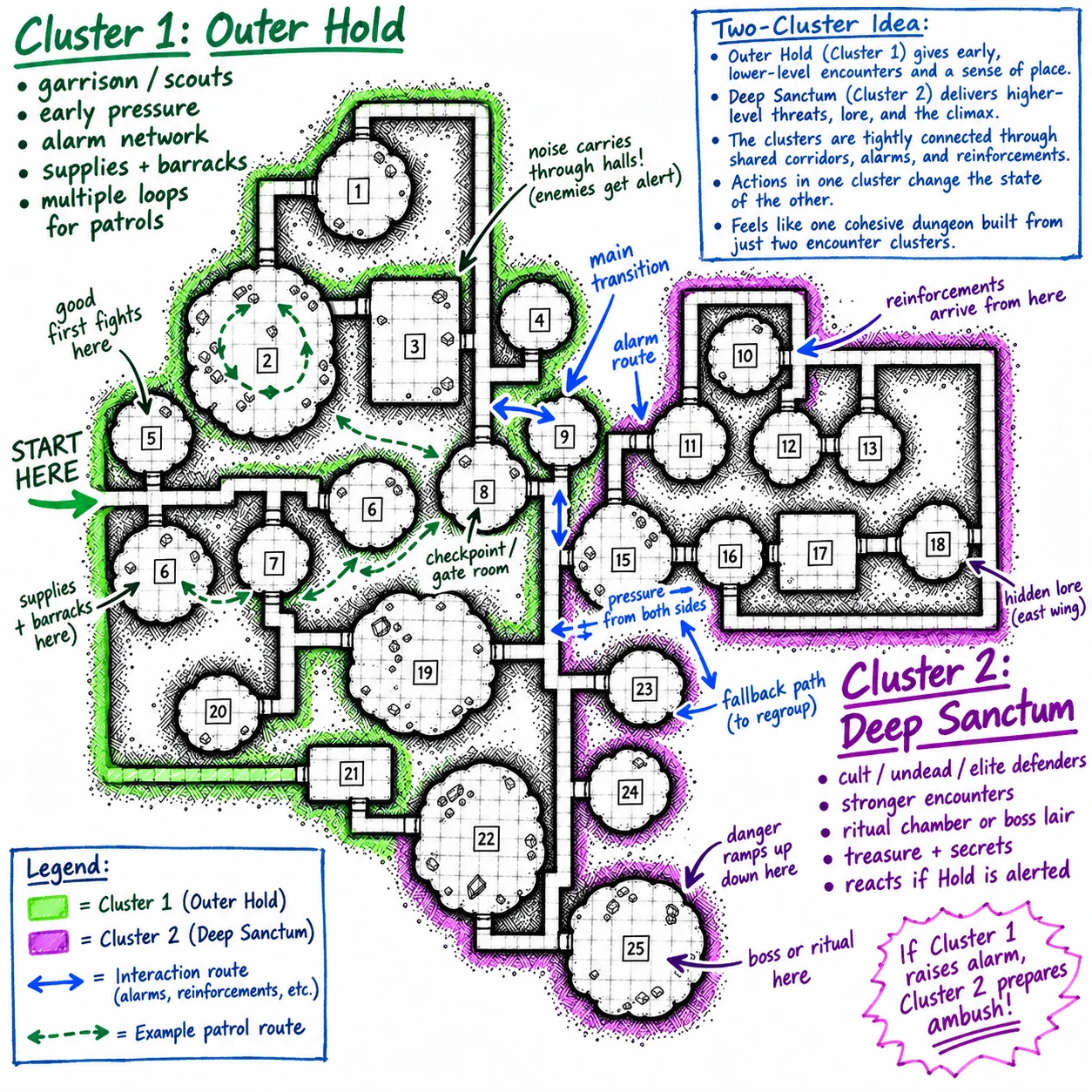
Draw two blobs before you draw a single room, and keep them close enough that the gap is smaller than either blob. Once the gap gets bigger you've drawn two dungeons and the players will treat them that way.
Then make the two sides different. This does more work than the spacing does, which is a slightly annoying thing to admit in a post about spacing. Two groups of identical rectangles are two groups of identical rectangles no matter how you space them. If the west side is a barracks and the east side is a crypt with the odd-shaped chambers and the niche walls, the naming starts in the first session and you don't have to wait for the third.
Connect the sides with two or three passages. If you use one you've built a chokepoint, and a chokepoint is a different design that wants different pacing around it.
The last trick is the cheapest one in the post. Put the stairs down inside one of the groups and keep them out of the gap. Now the party has to commit to a side to make progress, and the other side is a choice they made rather than a hallway they walked through.
Where the game goes from here#
Right now my generator gets the shape right and nothing else. The groups exist in space, but nothing downstream knows about them, so room contents, monsters, and stairs all get placed with no idea which side they're on.
The next step is passing that knowledge along. Give each side its own character so the naming has something to grab onto, keep monster groups together on one side so a fight actually draws in its neighbors, and put the stairs inside a group so the party has to choose. That's the hand-drawing advice above, taught to a machine. Whether it produces the same "let's finish the east side" conversations in a computer game that it does at a table is the experiment I'm most curious about, and I honestly don't know the answer.
So what gets named at your table?#
I think this is the most underrated of the four layouts and also the first one I'd cut, which is an irritating pair of opinions to hold at once. It's underrated because it's the cheapest way I know to get players planning. It's cuttable because the next layout does the same thing harder and hands you a real chokepoint on top.
So I'll ask the question I've been circling for the whole series. What's the last part of a dungeon your group gave a nickname to, and did the map earn it or did the monsters? My suspicion is that geography earns more of those names than we give it credit for, but I've been wrong about this kind of thing before and I'd like to hear it either way.
Drop a comment on X and let me know your thoughts!