I blame the BECMI Thief class for all of DnD's problems
How the BECMI Thief turned shared player ingenuity into one class's dice roll, and quietly traded D&D's player agency for character permissions.
I want to be upfront before the pitchforks come out. I do not actually believe a single character class invented in 1975 is responsible for everything that has gone sideways in tabletop design over the last fifty years. That would be insane. We are having a little fun with the title.
But...
There is a real thing buried under the joke, and the more I sit with it the more I think the Thief is where one specific bad idea entered the hobby and never left. Not "the Thief was weak," though it was. Something deeper than balance. The Thief is patient zero for the notion that abilities belong to characters instead of players. And that idea has been quietly poisoning the game ever since.
Let me explain. No, there is too much. Let me sum up.
The class that showed up late to its own party#
The Thief was not in the original game. When DnD landed in 1974 you had three things to be: the Fighting-Man, the Cleric, and the Magic-User. That was the whole menu. The Thief arrived a year later in a Greyhawk supplement, reportedly because players out in California wanted a sneaky dungeon-delver archetype the core trio did not cover.
So right away you can see what it was. Not a class somebody designed from a clean idea about what a rogue should be. A patch. A bolt-on to fill the "scout and trap guy" slot in a game that was suddenly full of locks, pits, and treasure nobody had a clean way to deal with. (HOlD ON all you 'but 10 foot pole!' people, we'll get to that. )
Mechanically, the Theif was pretty terrible mostly because the trap damage that was suppose to be attrition for the Fighter needed to be a danger. A d4 hit die and leather armor made the early Thief a stiff breeze away from death. Skill chances started somewhere in the 10 to 30 percent range, which meant your specialist failed at his specialty most of the time. BECMI (Basic, Expert, Companion, Master, Immortal) stretched advancement out across thirty-six levels, so the climb to competence took even longer than it did in B/X but the problems were the same in both. Backstab was fine on paper and terrifying to actually set up, because pulling it off required the stealth rolls you were probably going to blow. The classic low-level Thief experience was a string of failed percentile rolls followed by a funeral.
None of that is the interesting part.
The interesting part is what it did to everyone else at the table#
The thing the bad-balance complaints miss is, before the Thief existed, finding a trap was a conversation.
You told the DM you were tapping the floor ahead of you with a ten-foot pole. You said you were checking the door frame and the hinges. You poured a waterskin out to see which way it drained before stepping into the room. The trap got found, or did not, based on what you thought to do and how the DM ruled it. That was the game. Player says a thing, DM adjudicates, dice come out only when the outcome is genuinely uncertain. The whole loop ran on imagination and table conversation.
Sure it felt a bit like passive-aggressive Simon Says, but the Thief did not add trap-finding to DnD. Everyone was already doing it.
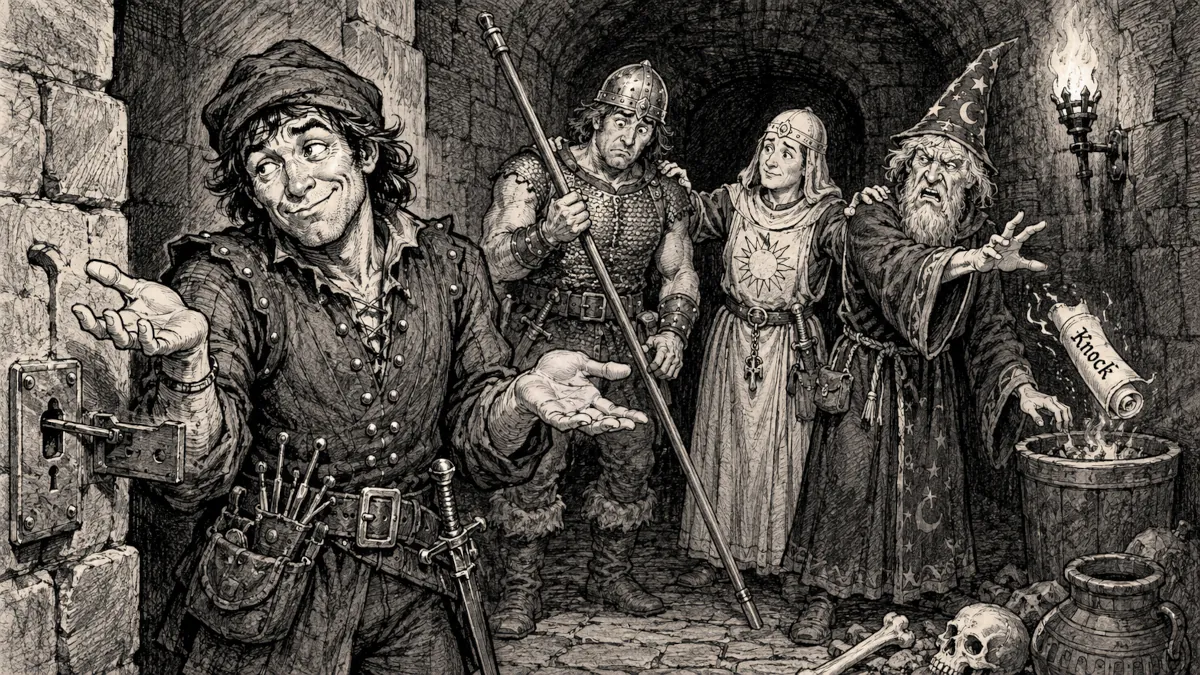
What the Thief did was take an activity the entire table shared and hand it to one guy with a percentage. And the moment that happened, an unspoken rule formed around it. If there is a Find Traps skill and only the Thief has it, then finding traps is the Thief's job, and the rest of you should probably stop poking around with your poles. Why would the Fighter describe checking the floor when there is a man whose character sheet literally says he does that? Worse, why would the DM reward the Fighter's clever description when the system has already decided this is a dice roll a specific class makes?
A shared verb became a class feature. That is the move. That is the whole post, honestly, and everything else is decoration.
Why are we picking locks when the fighter can just smash the hinge off the chest? Because we have the Thief class now!
Once you have seen it you cannot unsee it, because the game has been doing it ever since. Every later edition has expanded the list of things that are somebody's class feature rather than something anybody can attempt. Stealth, social maneuvering, even basic interaction with the world keeps getting absorbed into the sheet. Modern DnD is mostly a contest of "what does my character have permission to do," and the Thief is the first place I can point to and say, right there, that is where the permission slips started.
Focusing on character agency decreases the need for player agency. The Thief is where DnD first made that trade.
Now let me argue against myself, because I'm schizophrenic, and so am I#
There is a real defense of the Thief and I would be a hack if I pretended otherwise.
For one, the class is genuinely fun if you play it as a scout and an information engine rather than a skill-roll dispenser. A clever Thief player still describes the approach, still thinks about angles, still does the imaginative work, and treats the percentages as a backstop rather than the whole job. Played that way, the dice are a tiebreaker for the genuinely uncertain stuff, which is exactly what dice are for. Plenty of groups never lost the conversation at all. They just added a guy who was a little better at the sneaky parts.
For another, the early Thief actually levels up fast. Those low percentages climb quickly in the first handful of levels, and a Thief who survives to the mid-game becomes a real problem for locks and guards alike. The fragility is a feature if you think the game should punish carelessness, which old-school play very much does.
And honestly, the part of the Thief I want to hate the most is the part I should probably respect. Those percentile skills were the most forward-looking thing in the early game. They are the seed that RuneQuest and Harn and basically every skill-based system after them grew out of. I build a d100 roll-under system for my own MUD, Iron Blood and Omens, and if I am being honest about my lineage, the Thief's skill list is an ancestor of the thing I love most about my own design. So I am out here blaming the Thief for the death of player agency while quietly building on the exact mechanic that started it.
"Do I contradict myself? Very well then I contradict myself, I am large, I contain multitudes." Make of that what you will.
So what actually is the problem here?#
I do not think the percentile skills were the mistake. Skills are good. I would not be building what I am building if I thought otherwise.
The mistake was scoping the skills to a class instead of to the situation. The Thief did not need to be the only one who could pick a lock. It needed to be the one who was best at it, with everyone else still free to try and the dice still living in service of the fiction rather than replacing it. That is a small design difference with enormous downstream consequences, and DnD spent the next five decades taking the wrong fork over and over.
The OSR crowd figured this out, which is why so many retro-clones quietly delete the Thief and replace it with a Specialist who is just better at things anyone can attempt. They kept the skill and threw out the exclusivity. That is the correct read, and it took the hobby about thirty years to get there.
So no, the BECMI Thief did not cause all of DnD's problems. But it is the first place the game whispered that your character's permissions matter more than your ideas, and the hobby has been listening to that whisper ever since.
Am I being unfair to a poor squishy d4 specialist who never asked to carry this much blame? Almost certainly. Did your group keep the conversation alive, or did the man with the Find Traps percentage quietly retire everyone else's ten-foot poles? I want to hear about it, especially if you think I have got this backward.
Drop a comment on X and let me know your thoughts!