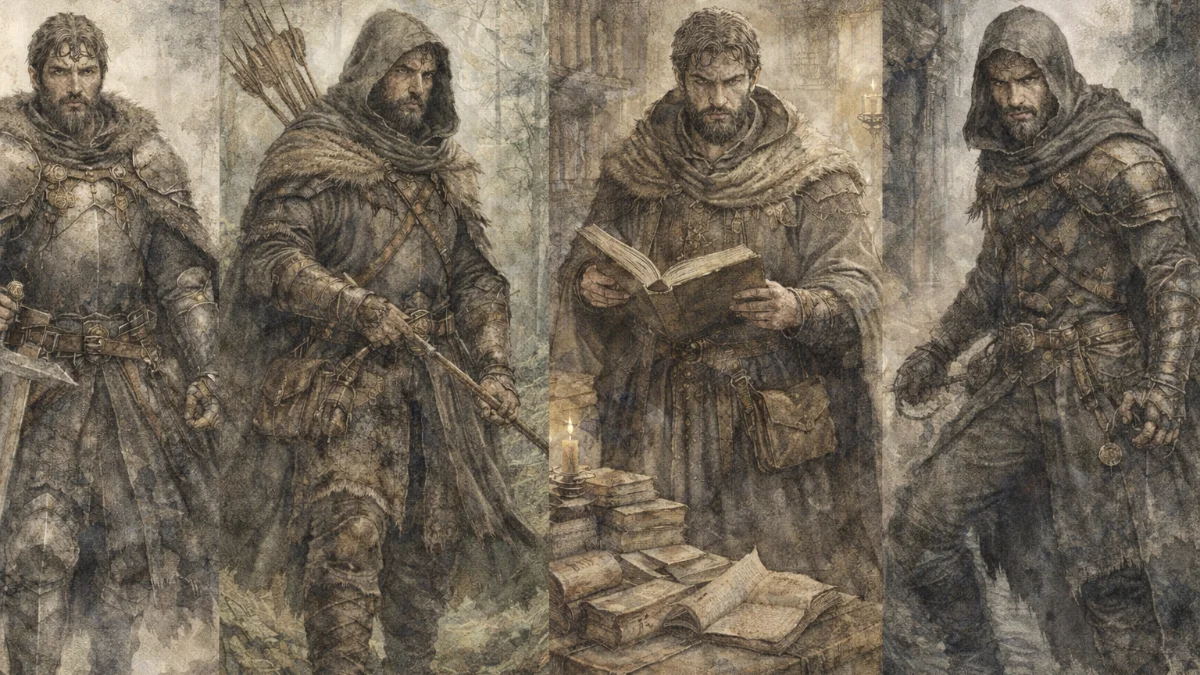
IBO Design Diary: What your character is made of
A deep dive into IBO's character system: nine characteristics, d100 skill rolls, backgrounds, apprenticeships, and the Rule of 5.
I wanted to write a design diary post about the game design elements (i.e. not technical development) of character creation, because they are the foundation of everything else. The systems that govern combat, crafting, social interaction, and exploration all build on top of the character design. If I can explain the core principles of how characters are built and what the numbers mean, it will make the future posts about specific systems easier to understand.
When I first sat down to prototype Iron, Blood & Omens, the plan was to use something familiar. D&D-style classes, six ability scores, the works. I figured I could skin it gritty and call it done. That lasted about a week.
D&D is a great game. But the things that make it work for a weekly session around a table don't hold up the way I needed them to in a persistent online world. Itemization in D&D is designed for treasure parcels doled out over months of play. Classes give you a bundle of abilities on level-up that make sense when you're advancing once every few sessions. But in a game where players are online for hours, fighting things, gathering herbs, picking locks, and running into each other in taverns, you need finer grain than that. You need a system where the difference between a character with a 34% sword skill and one with a 52% sword skill actually means something in every single fight.
So I drifted toward percentile skill-based systems. Basic Roleplaying. Harnmaster. These felt closer to what I wanted, a world where your character is defined by what they can do rather than what class they picked at level one. But I kept pulling away from those too, borrowing pieces and discarding others. Ideas from Burning Wheel's skill development. Kingdom Come: Deliverance 2's sense of earned progression. My own decades of running and playing tabletop games. All of it went into the pot.
What came out the other end is the IBO system. A d100 roll-under game with nine characteristics, skill-based resolution, and a character creation process that produces people instead of archetypes. This post covers the design fundamentals: how characters are built, what the numbers mean, and why I made the choices I did.
Nine characteristics#
IBO uses nine characteristics that represent your character's innate, unlearned abilities. If you've played Harnmaster or Pendragon, the structure will feel familiar. If you're coming from D&D, you'll notice a few extras.
Strength (STR) is physical force. It affects melee damage, how much armor you can wear without penalty, and whether you can kick open a stuck door.
Constitution (CON) is resilience. How much punishment your body absorbs before it starts failing. This is the single most important stat for staying alive, because it directly feeds into wound thresholds and how long you stay on your feet in a fight.
Speed (SPD) is reaction time and reflexes. Initiative in combat, dodging, and how quickly you respond when something goes wrong.
Dexterity (DEX) is coordination and precision. Blade work, lockpicking, stealth, the fine motor skills that separate a clumsy swing from a clean one.
Intelligence (INT) is reasoning. It feeds into knowledge skills, research, medicine, and your ability to figure things out under pressure.
Power (POW) is force of will and inner potential. Luck, magical aptitude, and that quality some people have where they just seem harder to curse.
Charisma (CHA) is social presence. Not beauty, specifically. More the ability to hold a room, command attention, or talk your way past a guard who doesn't want to let you in.
Willpower (WIL) is mental fortitude. Your resistance to fear, pain, and the urge to run when the fight turns ugly. Different from Power in the same way stubbornness is different from talent.
Perception (PER) is awareness and instinct. Noticing the tripwire, hearing the footstep behind you, reading the body language of someone who's about to draw a knife.
Characters are generated by rolling 4d6 and dropping the lowest die for each characteristic, assigned in order. No rearranging (thought we're likely to allow a swap before the testing release). Average humans land around 10-11 on each stat, with peak human potential at 18. You play what the dice give you, and the rest of character creation builds around those results.
I went with nine instead of the traditional six because I wanted to separate things that D&D bundles together. Wisdom in D&D covers perception, willpower, and spiritual power all in one score. IBO splits those into three distinct characteristics (PER, WIL, POW) because they drive very different gameplay. A character with sharp senses but weak resolve plays completely differently from one who's stubborn as iron but couldn't spot an ambush to save their life. That distinction matters in a persistent world where every roll counts.
What the system derives from your stats#
From those nine characteristics, the system calculates several values that govern how your character performs under stress.
First, each characteristic has a corresponding characteristic roll at five times its value. Effort (STR x 5) is your raw physical exertion check. Stamina (CON x 5) determines if you stay on your feet after a gut punch. Reflexes (SPD x 5) is your initiative roll. Idea (INT x 5), Luck (POW x 5), Agility (DEX x 5), Presence (CHA x 5), Resolve (WIL x 5), and Clarity (PER x 5) all serve as quick percentile tests when the situation calls for a raw characteristic check rather than a trained skill. A character with CON 12 has a Stamina of 60%, which means they pass that check more often than not. A character with POW 9 has a Luck of 45%, which is about as unreliable as you'd expect.
Beyond those, the system calculates a handful of derived statistics.
Damage Bonus is STR minus 11. Average strength gives you nothing extra. Every point above average adds one to your melee damage. Every point below takes one away.
Armor Tolerance equals your STR score and determines how much armor you can wear before it starts slowing you down. A character with STR 14 can handle heavier gear than one with STR 10, which is the kind of thing that matters when you're deciding between a mail hauberk and a leather jerkin.
Power Points equal your POW score, representing magical energy. These matter more as the game's mystical systems develop.
Two other derived stats, Wound Threshold and Resilience, are the numbers that make combat in IBO feel dangerous. They control when a hit crosses from a scratch to real trauma, and how long you can keep fighting as wounds pile up. Both are derived from CON (with WIL contributing to Resilience), and I'll dig into them properly in the combat design log. For now, the takeaway is simple: CON keeps you alive, and characters with low CON know it every time steel comes out.
Skills and where they come from#
Skills are where IBO really diverges from class-based systems. Your character doesn't get a package of abilities tied to a class. Instead, every skill has a base value calculated from two of your nine characteristics.
Melee: Sword is STR plus DEX. Awareness is PER plus POW. Athletics is STR plus CON. Medicine is INT plus PER. Every skill draws from a specific pair of characteristics, which means your stat rolls create a natural aptitude profile before you've made any choices at all.
A character who rolled high STR and DEX has natural talent with swords and fine bladework. One with high PER and WIL is naturally observant, good at survival, and resistant to fear. The stats shape what your character is good at, and the training you choose during creation determines what they've actually practiced.
These characteristic pairings create natural clusters. A high-DEX, high-SPD character is naturally gifted at Dodge, Stealth, Small Blade, and Thievery. A high-STR, high-CON character excels at Athletics, Shield, Great Hafted weapons, and Smithing. The stats you rolled tell a story about who this person is before you've made a single choice.
Some skills start at a flat 5% base until learned through training. Lore, Medicine, Research, Command, Diplomacy, the Craft skills, and several others fall into this category. An untrained character still has that 5% floor (everyone gets lucky sometimes), but they don't benefit from their characteristics until they've actually learned the basics. Backgrounds and apprenticeships open these gated skills, replacing the flat 5% with the full characteristic-derived base plus any training bonuses.
The system has around thirty skills spread across physical, combat, mental, social, and knowledge categories. I deliberately avoided the common TTRPG problem of having twenty skills on the sheet where five get used in every session and the rest are decoration. If a skill is on the sheet, it has mechanical weight in the game. I'll publish the full skill list with base formulas as a reference page, but the important thing to understand here is the design principle: your characteristics define your potential, and your training defines what you've done with it.
Rolling the bones#
IBO uses a d100 roll-under system. Roll two ten-sided dice, read the result as a number from 01 to 100, and try to get equal to or under your skill percentage. That's the core of resolution. If your Melee: Sword skill is 52%, you need to roll 52 or lower to hit.
Rolls of 96 through 100 always fail, regardless of skill. Rolls of 01 through 05 always succeed, even for untrained characters sitting at 5%. Nobody is ever guaranteed success, and nobody is ever completely helpless. That floor and ceiling keep the dice honest.
The system also supports difficulty modifiers. An easy check doubles your effective skill. A difficult check halves it. These adjustments are straightforward and fast, which matters in a game that resolves dozens of checks in a single combat encounter.
If you've played Harnmaster, Basic Roleplaying, or RuneQuest, this foundation is intentionally familiar. I wanted the resolution system to feel immediately comfortable for players coming from those traditions. Percentile roll-under is simple and fast, and there's no reason to reinvent it. Where IBO gets interesting is in what it builds on top of that foundation. But I'll save that for a future design log.
Backgrounds#
Your background is where your character came from before their story started. It's not destiny. It's just origin. Each background grants a +10% bonus to four skills and establishes the kind of instincts your character developed growing up.
IBO currently has ten backgrounds:
| Background | Skills (+10% each) |
|---|---|
| Peasant | Survival, Athletics, Forage, Awareness |
| Townsfolk | Persuade, Barter, Awareness, Stealth |
| Noble | Diplomacy, Command, Lore, Riding |
| Cloistered | Lore, Research, Medicine, Persuade |
| Outcast | Stealth, Thievery, Intimidate, Survival |
| Outlander | Survival, Forage, Herbalism, Unarmed |
| Servant | Awareness, Thievery, Diplomacy, Persuade |
| Rover | Survival, Awareness, Riding, Barter |
| Performer | Perform, Persuade, Thievery, Athletics |
| Guildborn | Craft (choice), Barter, Mechanisms, Lore |
Each background also comes with narrative hooks, specific fragments of backstory that suggest possible threads without demanding resolution. The reeve who seized your family's grain. The sealed letter your master burned without reading. Things like that. Not plot requirements, just possibilities.
I wanted backgrounds to feel like a life lived, not a character class in disguise. A Peasant who becomes a physician is a different kind of healer than a Cloistered scholar who studied medicine in a monastery. Both end up with the Medicine skill, but they got there different ways, and their other skills reflect that journey.
Apprenticeships#
Your apprenticeship is what you did for a living before adventure found you. This is the heavier investment. Each apprenticeship distributes 90 percentage points across six skills in a tiered structure: one core skill at +25%, three secondary skills at +15% each, and two tertiary skills at +10% each.
The apprenticeships are organized into five categories.
Combat#
| Apprenticeship | Core (+25%) | Secondary (+15%) | Tertiary (+10%) |
|---|---|---|---|
| Man-at-Arms | Melee weapon (choice) | Shield, Athletics, Melee weapon (choice) | Intimidate, Craft: Smithing |
| Squire | Melee weapon (choice) | Command, Shield, Riding | Medicine, Lore |
| Militia | Melee weapon (hafted/great hafted/polearm) | Ranged weapon (choice), Dodge, Awareness | Survival, Athletics |
Exploration#
| Apprenticeship | Core (+25%) | Secondary (+15%) | Tertiary (+10%) |
|---|---|---|---|
| Scout | Awareness | Stealth, Survival, Ranged weapon (choice) | Athletics, Dodge |
| Hunter | Ranged weapon (choice) | Survival, Stealth, Awareness | Herbalism, Forage |
| Wayfarer | Survival | Diplomacy, Awareness, Barter | Perform, Lore |
| Mariner | Athletics | Survival, Awareness, Mechanisms | Melee: Small Blade, Barter |
Knowledge#
| Apprenticeship | Core (+25%) | Secondary (+15%) | Tertiary (+10%) |
|---|---|---|---|
| Scholar | Lore | Research, Persuade, Diplomacy | Awareness, Craft: Alchemy |
| Physician | Medicine | Herbalism, Craft: Alchemy, Awareness | Persuade, Research |
| Acolyte | Lore | Persuade, Awareness, Command | Medicine, Perform |
Trade#
| Apprenticeship | Core (+25%) | Secondary (+15%) | Tertiary (+10%) |
|---|---|---|---|
| Laborer | Athletics | Craft: Woodworking, Mechanisms, Survival | Melee: Hafted, Awareness |
| Artisan | Craft (choice) | Craft (choice), Barter, Mechanisms | Awareness, Persuade |
| Merchant | Barter | Persuade, Diplomacy, Awareness | Lore, Perform |
Subterfuge#
| Apprenticeship | Core (+25%) | Secondary (+15%) | Tertiary (+10%) |
|---|---|---|---|
| Scoundrel | Thievery | Stealth, Mechanisms, Awareness | Dodge, Melee: Small Blade |
| Charlatan | Perform | Persuade, Diplomacy, Awareness | Lore, Stealth |
Some apprenticeships include choices marked in the tables. A Man-at-Arms picks their primary and secondary weapon specialties. A Hunter chooses their ranged weapon. An Artisan picks which crafts they've trained in. These choices create further differentiation, so two Man-at-Arms characters with different weapon picks play differently from the start.
After choosing a background and apprenticeship, you get 50 free interest points to distribute across any skills that are still below 50%. This is where you customize. Maybe your soldier has a secret interest in herbalism. Maybe your merchant practiced with a blade when nobody was watching. These points let you round out a character without breaking the core identity your background and apprenticeship established.
The rule of 5#
This is the piece that gives the system its teeth.
After every d100 roll, look at the ones digit. If it ends in a 0 or a 5, the result is critical. A successful roll ending in 0 or 5 is a Critical Success. A failed roll ending in 0 or 5 is a Critical Failure. Everything else is a normal success or normal failure.
That means 20% of all rolls have the potential to be critical. Not rare enough to forget about, not common enough to lose their weight. You feel it every time you see that 5 or 0 on the ones die.
Critical Successes represent perfect execution. In combat, they produce the best possible hit. Outside combat, they mean exceptional results: the lock yields silently on the first try, the herbal remedy works better than expected, the persuasion lands exactly right. And they mark the skill for development, meaning that skill has a chance to permanently improve during your next rest period.
Critical Failures are catastrophic errors. Fumbled attacks, snapped lockpicks, botched treatments. They also mark the skill for development, because the IBO philosophy is that you learn as much from disaster as from perfection. A character who critically fails their Sword skill today might, during their next long rest, roll a development check and gain a permanent +1% to that skill. Hard lessons stick.
Development works like this. When you rest, you roll d100 for each marked skill. If that roll exceeds your current skill value, the skill improves by 1%. A character at 25% improves 75% of the time when they've earned a mark. A character at 85% only improves 15% of the time. Skills get harder to develop as you get better, which creates natural specialization curves. Characters don't advance uniformly. They grow in the directions where they're being tested.
I chose the Rule of 5 because it's easy to internalize. Players don't need to memorize a crit range table or do math in their heads. Every roll, check the last digit. Five or zero? Something significant just happened. It becomes second nature after a few sessions, and it gives every single roll a little bit of tension beyond the simple pass/fail question.
A sample character#
Here's what a starting character looks like once all the pieces come together. This is Aldric, a farm boy from the outskirts of Thornfield who signed up with a mercenary company and spent his apprenticeship learning to fight with sword and shield.
+--------------------------------------------------------------+
|  Aldric                         Peasant / Man-at-Arms         |
+--------------------------------------------------------------+

  Characteristics
  STR  14    CON  12    SPD  11    INT  10    POW   9
  DEX  13    CHA   8    WIL  11    PER  12

  Characteristic Rolls
  Effort    70%    Stamina   60%    Reflexes  55%    Idea      50%
  Luck      45%    Agility   65%    Presence  40%    Resolve   55%
  Clarity   60%

  Derived Statistics
  Wound Threshold   48        Resilience       12
  Damage Bonus      +3        Power Points    9/9
  Armor Tolerance   14

  Physical              Combat                   Mental
  Athletics      51%    Melee: Sword      52%    Awareness      41%
  Dodge          39%    Melee: Hafted     42%    Research        5%
  Stealth        34%    Shield            41%    Survival       43%
  Riding         22%    Unarmed           25%
                        Ranged: Bow       25%

  Social                Knowledge
  Command         5%    Barter            18%
  Diplomacy       5%    Craft: Smithing   36%
  Intimidate     35%    Forage            34%
  Persuade       23%    Herbalism          5%
  Perform        19%    Lore               5%
                        Medicine           5%
                        Mechanisms         5%
                        Thievery           5%
Aldric's STR 14 gives him a +3 Damage Bonus on every melee hit and lets him wear heavier armor comfortably. His Peasant background gave him baseline competence in Survival, Athletics, Forage, and Awareness, the practical instincts of someone who grew up working fields and watching the horizon. His Man-at-Arms apprenticeship pushed Melee: Sword to 52% and Shield to 41%, with secondary training in Athletics (now 51% with the background bonus stacking) and Hafted weapons. He picked up some Intimidate and basic Smithing along the way, because soldiers maintain their own gear.
His 50 free interest points went into Dodge, Awareness, Survival, Stealth, and a touch of Persuade. Things he picked up on the road between the farm and the company.
Look at all those 5% entries in the Knowledge column. That's an honest picture of a former farm boy who trained as a soldier. He doesn't know medicine. He can't pick a lock. He's never studied alchemy or opened a book of lore. But he can swing a sword, raise a shield, and survive in the field. That's enough to start, and everything else is something he might learn along the way.
What comes next#
I've laid out the foundation here. Characteristics, skills, backgrounds, apprenticeships, and the roll-under system with the Rule of 5. This is what every character in IBO is built on.
But I've deliberately saved some of the most interesting design work for future posts. The resolution system goes deeper than a single d100 roll. There's a system I call the Progressive Resolution System that builds on this foundation, giving skilled characters multiple rolls that accumulate into quality tiers. It's the piece that makes combat, lockpicking, herbalism, and eventually crafting all feel connected and meaningful. And it's the piece I'm most excited about.
Beyond that, I still need to cover wounds and damage (where Wound Threshold and Resilience really come to life), armor and combat, and the three peoples of the Shattered March: Humans, Dwarves, and Elves. Plenty of design logs ahead.
For now, I'd love to hear your reactions. Does the characteristic set make sense to you? Do the background and apprenticeship combinations spark any character ideas? If you've played Harnmaster, BRP, or Pendragon, does this feel like familiar territory or something genuinely different? And if you're sitting there thinking "this is just Harn with extra steps," well, you're not entirely wrong. But I think those extra steps earn their keep. Let me know what you think.
Drop a comment on X and let me know your thoughts!